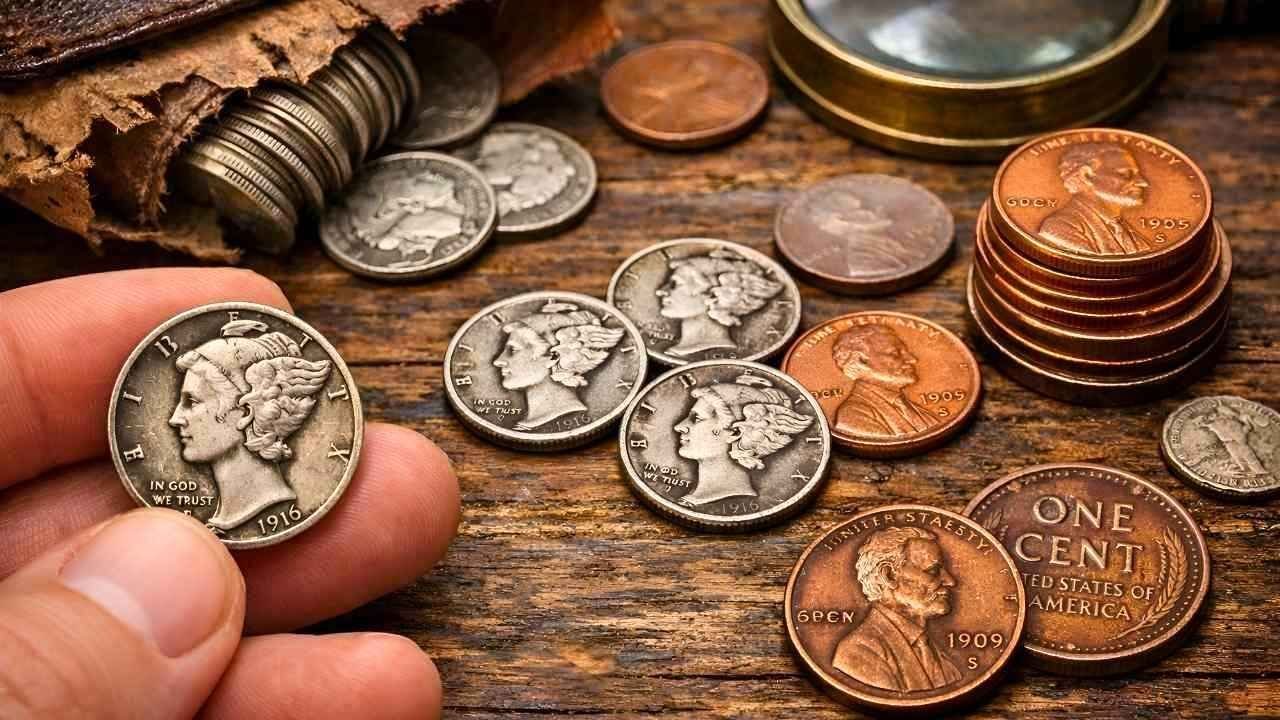
In the world of tangible assets, few collectibles combine history, artistry, and explosive upside potential like rare U.S. coins. In 2026, elite collectors and strategic investors continue to compete for key-date Mercury Dimes and Lincoln Pennies — coins that once circulated as everyday pocket change but now command five-, six-, and even seven-figure prices.
This comprehensive guide highlights 20 of the most valuable Mercury Dimes and Lincoln Cents, explaining what makes them rare and why demand remains strong in today’s premium collectibles market.
The Legacy of the Mercury Dime
Officially known as the Winged Liberty Head Dime, the Mercury Dime was minted from 1916 to 1945. Designed by Adolph A. Weinman, the coin features Liberty wearing a winged cap symbolizing freedom of thought. Its reverse displays a fasces and olive branch — representing strength and peace.
Collectors admire the series for its short run, elegant design, and concentration of key rarities.
The Legacy of the Lincoln Cent
Introduced in 1909 to honor Abraham Lincoln, the Lincoln cent became the first U.S. coin to depict a real historical figure. Designed by Victor David Brenner, the original reverse featured two wheat stalks — giving rise to the popular “Wheat Penny” nickname.
More than a century later, rare dates and dramatic mint errors have elevated certain Lincoln cents into blue-chip numismatic assets.
10 Ultra Rare Mercury Dimes (Value Highlights 2026)
Below are the most sought-after Mercury Dimes, with approximate high-grade auction ranges:
1. 1916-D Mercury Dime
The undisputed key date of the series. Low mintage and extreme scarcity in Mint State.
High-grade value: $50,000 – $250,000+
2. 1921 Mercury Dime
Scarce post-war issue with limited production.
High-grade value: $10,000 – $100,000
3. 1921-D Mercury Dime
Denver-minted rarity with strong collector demand.
High-grade value: $15,000 – $150,000
4. 1942/1 Overdate (Philadelphia)
Famous overdate error with visible 1941 beneath 1942.
High-grade value: $20,000 – $120,000
5. 1942/1-D Overdate
Even scarcer Denver overdate variety.
High-grade value: $30,000 – $200,000+
6. 1926-S Mercury Dime
Weak strikes make fully detailed examples rare.
High-grade value: $8,000 – $75,000
7. 1931-D Mercury Dime
Low mintage and difficult in uncirculated condition.
High-grade value: $5,000 – $40,000
8. 1925-D Mercury Dime
Condition rarity with limited Mint State survivors.
High-grade value: $5,000 – $60,000
9. 1927-S Mercury Dime
Scarce in higher grades.
High-grade value: $6,000 – $80,000
10. 1938 Mercury Dime
Low mintage final-era issue, popular among set builders.
High-grade value: $3,000 – $25,000
10 Ultra Rare Lincoln Pennies (Value Highlights 2026)
Lincoln cents feature some of the most dramatic error coins in American history.
11. 1909-S VDB Lincoln Cent
Low mintage with designer initials on reverse.
High-grade value: $50,000 – $200,000+
12. 1914-D Lincoln Cent
Essential key date for collectors.
High-grade value: $20,000 – $150,000
13. 1922 No D Lincoln Cent
Denver issue struck without visible mint mark.
High-grade value: $25,000 – $120,000
14. 1931-S Lincoln Cent
Low mintage Depression-era rarity.
High-grade value: $3,000 – $40,000
15. 1943 Copper Lincoln Cent
Legendary wartime mint error struck in copper instead of steel.
Top examples have exceeded $1,000,000.
16. 1955 Doubled Die Lincoln Cent
Bold doubling visible without magnification.
High-grade value: $20,000 – $150,000
17. 1969-S Doubled Die Lincoln Cent
Rare and dramatic doubled die error.
High-grade value: $30,000 – $200,000+
18. 1972 Doubled Die Lincoln Cent
Strong obverse doubling, highly collectible.
High-grade value: $5,000 – $100,000
19. 1992 Close AM Lincoln Cent
Reverse variety with tight AM spacing in “AMERICA.”
High-grade value: $5,000 – $25,000+
20. 1999 Wide AM Lincoln Cent
Unusual spacing variety on reverse.
High-grade value: $2,000 – $15,000+
Why These 20 Coins Command Premium Prices
Three forces drive extraordinary value:
Rarity
Low mintages, die errors, and limited surviving high-grade specimens constrain supply.
Condition
Grade determines price. A Mint State coin with original luster and sharp details can be worth exponentially more than a circulated example.
Demand
Both Mercury Dimes and Lincoln Cents benefit from massive collector bases. High-net-worth individuals, registry competitors, and long-term investors compete for the finest known examples.
Condition and Professional Grading
Coins are graded on a 1–70 scale. In upper Mint State levels (MS65+), even a single point difference can represent thousands of dollars.
Key grading considerations include:
- Strike sharpness
- Surface preservation
- Luster quality
- Eye appeal
Third-party certification enhances liquidity and market trust, especially for five- and six-figure coins.
2026 Market Outlook
The rare coin market remains resilient in 2026. Investors increasingly view premium numismatics as alternative assets that combine intrinsic metal value with collectible scarcity.
Record-setting auctions continue for top-population examples of the 1916-D Mercury Dime and the 1943 Copper Lincoln Cent. Registry-level competition further drives price growth in the highest grades.
Unlike purely commodity-based assets, rare coins derive strength from cultural and historical significance — a powerful value driver in uncertain economic climates.
Smart Collecting Strategy
For serious collectors and investors:
- Focus on certified high-grade examples
- Prioritize eye appeal over quantity
- Research population reports for scarcity insight
- Store coins in climate-controlled environments
- Think long-term rather than short-term speculation
Strategic acquisitions in the right grade tiers can significantly outperform average market returns over time.
Final Perspective
Mercury Dimes and Lincoln Pennies represent more than metal. They embody American craftsmanship, history, and the enduring appeal of tangible wealth.
From the iconic 1916-D Mercury Dime to the legendary 1943 Copper Lincoln Cent, these 20 coins define the upper tier of small-denomination U.S. rarities. In 2026, they remain highly sought after by collectors and investors who recognize that true value often hides in unexpected places.
For those who appreciate history you can hold — and assets that combine beauty with performance — these coins offer both legacy and opportunity.