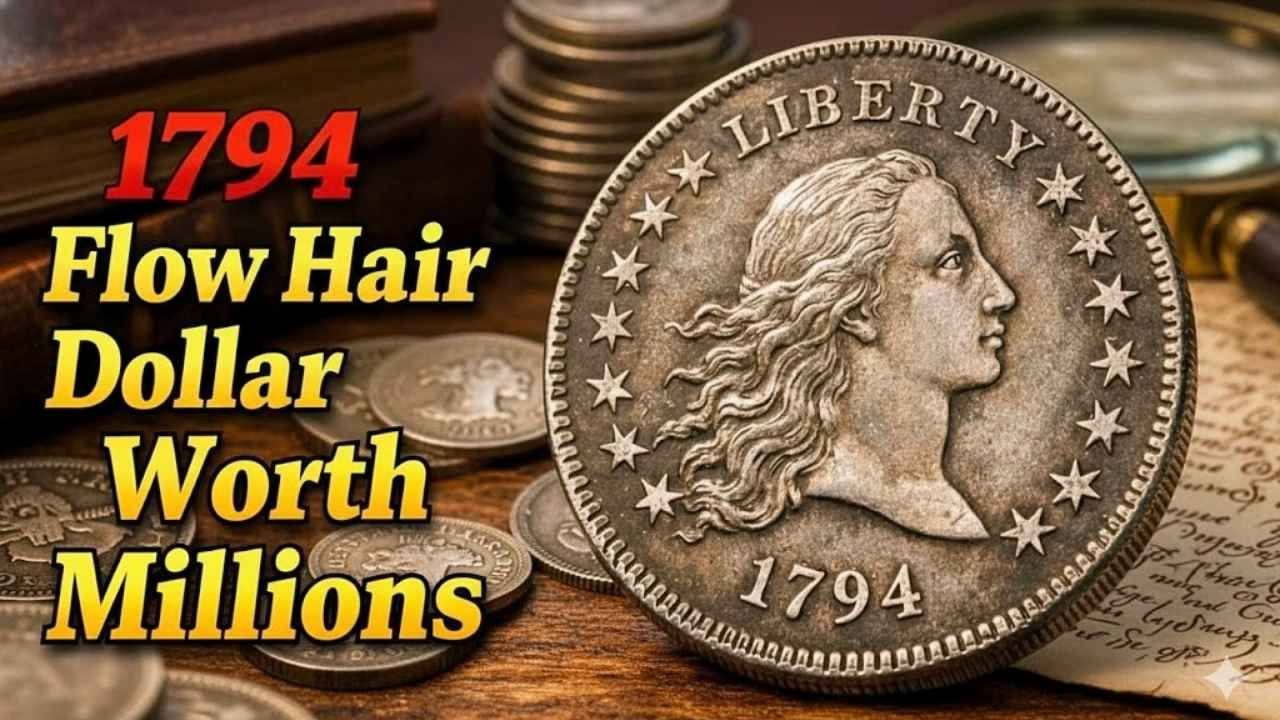
The 1794 Flowing Hair Dollar stands at the pinnacle of American numismatics. Revered as the first official silver dollar struck by the United States government, this legendary coin represents the financial foundation of a young republic. More than two centuries later, it continues to command global attention—regularly achieving multi-million-dollar prices at elite auctions.
For collectors, historians, and investors alike, the 1794 Flowing Hair Dollar is more than rare currency. It is a tangible symbol of national identity, craftsmanship, and enduring value.
The Birth of America’s First Silver Dollar
Following the establishment of the United States Mint in 1792, the nation sought to create a standardized monetary system. By 1794, the Mint in Philadelphia was prepared to strike its first silver dollars.
The 1794 Flowing Hair Dollar was designed by Robert Scot, the first Chief Engraver of the United States Mint. His design reflects the ideals of liberty and independence that defined the post-Revolutionary era.
Only about 1,758 coins were struck in 1794, and far fewer survive today. Many were lost, melted, or heavily circulated. This extremely limited surviving population is a primary reason for the coin’s extraordinary rarity.
Design and Symbolism
The artistry of the 1794 Flowing Hair Dollar captures the spirit of a newly independent nation.
Obverse: Liberty in Motion
The obverse features Lady Liberty with flowing hair, facing right. Her untamed hair symbolizes freedom and the rejection of monarchy. Surrounding her are stars representing the original states, along with the date 1794.
Reverse: Strength and Sovereignty
The reverse displays an eagle encircled by a wreath—an early representation of American strength and unity. The inscription “UNITED STATES OF AMERICA” reinforces national identity.
The design is elegant yet bold, embodying both artistic refinement and political symbolism. Collectors value not only the coin’s rarity but also its historical storytelling.
Why the 1794 Flowing Hair Dollar Is Worth Millions
Several factors contribute to the coin’s remarkable market value:
1. Historical Significance
As the first official silver dollar struck by the United States Mint, it represents the birth of America’s federal coinage system. That alone places it among the most important coins in world history.
2. Limited Mintage and Survival Rate
While approximately 1,758 pieces were originally struck, experts estimate that only around 120–150 examples exist today in all conditions. High-grade specimens are exceptionally rare.
3. Condition and Preservation
Condition dramatically influences value. Coins graded in Mint State condition—especially those with sharp strike details and original luster—command premium prices. Proof-like surfaces, mirror-like fields, and minimal wear significantly elevate desirability.
4. Market Demand
Elite collectors and investors compete aggressively for top examples. Trophy coins with historical prominence often transcend traditional asset categories, becoming generational wealth pieces.
Record-Breaking Auction Sales
The 1794 Flowing Hair Dollar has repeatedly shattered auction expectations.
In 2013, a nearly pristine specimen sold for more than $10 million, setting a world record for the most expensive coin ever sold at the time. This example was widely believed to be among the first coins struck, possibly the very first silver dollar produced by the Mint.
Other high-quality specimens have sold for millions, reinforcing the coin’s blue-chip status within the rare coin market.
These headline-making sales have elevated the Flowing Hair Dollar into the realm of elite collectible assets—comparable to museum-quality artwork or historic manuscripts.
Grading, Authentication, and Market Confidence
Given its value, authentication is critical. Professional grading services evaluate condition, strike quality, luster, and surface preservation. Coins are graded on a scale ranging from Poor (heavily worn) to Mint State (uncirculated).
Top-tier examples often carry numerical grades in the high Mint State range. Even small differences in grade can mean millions of dollars in price variation.
Encapsulation in secure holders ensures authenticity and protects the coin from environmental damage. For serious buyers, third-party grading provides confidence and liquidity in the marketplace.
Market Trends in 2026
As of 2026, the market for the 1794 Flowing Hair Dollar remains exceptionally strong. Ultra-rare coins with historical significance continue to attract institutional investors and global collectors seeking tangible assets.
In an era of financial volatility, rare coins with documented provenance and limited supply are viewed as stable, long-term stores of value. The Flowing Hair Dollar, with its unmatched legacy, remains at the forefront of this trend.
Demand is especially intense for:
- High-grade Mint State examples
- Coins with proof-like surfaces
- Specimens with distinguished ownership history
- Early die-state strikes
Market analysts consistently classify it as one of the most desirable American coins ever produced.
Collecting Considerations
Owning a 1794 Flowing Hair Dollar is a dream reserved for a select group of collectors. Most surviving examples reside in major collections or are traded through elite auction houses.
For those pursuing acquisition:
- Study auction archives and price trends
- Work only with reputable dealers or auction firms
- Verify third-party grading and provenance
- Ensure proper insurance and secure storage
Because of its rarity, opportunities to purchase one are infrequent. When examples appear on the market, competition is intense.
Investment Perspective
From an investment standpoint, the 1794 Flowing Hair Dollar represents the pinnacle of numismatic assets.
Its appeal rests on three pillars:
- Historical importance
- Absolute rarity
- Consistent global demand
Unlike modern bullion coins, its value is not tied solely to silver content. Instead, it derives from scarcity, cultural significance, and collector prestige.
Over decades, the coin has demonstrated strong appreciation, particularly for top-grade specimens. For ultra-high-net-worth collectors, it functions as both a legacy asset and a portfolio diversifier.
Key Highlights
- Recognized as America’s first official silver dollar
- Designed by Robert Scot, first Chief Engraver of the U.S. Mint
- Approximately 1,758 struck; far fewer survive today
- Record sale exceeding $10 million
- High-grade examples rank among the most valuable coins in the world
- Remains a premier collectible asset in 2026
Final Thoughts
The 1794 Flowing Hair Dollar is not merely a rare coin—it is a foundational artifact of American history. It captures the ambition of a new nation, the artistry of early mint craftsmanship, and the enduring allure of scarcity.
In today’s global collectible market, few assets combine historical depth, aesthetic beauty, and financial strength as seamlessly as this iconic silver dollar. For those fortunate enough to encounter one, it represents the highest expression of numismatic excellence—and a lasting symbol of America’s first steps into economic sovereignty.